
Last updated September 23, 2026
Seasonal Insulation Care for Long Beach: Year-Round Homeowner’s Guide
Most Long Beach homeowners check their attic insulation depth once a year, usually in November, and they check it at the access hatch where it’s easiest to reach. That single measurement tells you almost nothing. In our experience across 9,000+ homes since 2016, the most telling sign of insulation failure in this specific climate shows up as a depth gradient - loose-fill packed against the downwind eaves after Santa Ana events, thin in the center, normal at the hatch. The hatch reading looks fine. The attic is compromised. This guide - alongside The Complete Guide to Insulation in Long Beach - maps what to actually inspect, when, based on Long Beach’s four real climate modes: marine layer spring, dry summer, Santa Ana fall, and cool-wet winter.
Quick Answer
Seasonal insulation care in Long Beach means inspecting your attic and crawl space four times yearly, aligned to local climate modes rather than calendar months. Key actions: check for marine layer moisture on the attic deck in spring, monitor HVAC runtime spikes in summer, inspect for wind-shifted loose-fill at eaves after Santa Ana events, and trace water intrusion paths after winter rains. A simple three-point log - utility kWh, HVAC runtime hours, and one attic depth measurement - builds a performance history that catches problems before they show up on your bill.
Table of Contents
- Marine Layer Spring (April-June): When Humidity Hides at the Attic Deck
- Dry Summer (July-September): HVAC Runtime as Your Diagnostic Tool
- Santa Ana Fall (September-November): The Wind That Moves Your Insulation
- Cool-Wet Winter (December-February): Tracing Water Before It Wicks
- How to Keep a Seasonal Log That Actually Matters
- Common Mistakes to Avoid
- When to Call a Professional
- Frequently Asked Questions
Marine Layer Spring (April-June): When Humidity Hides at the Attic Deck
Long Beach’s marine layer isn’t a morning inconvenience. It’s a sustained weather pattern that can last weeks in April through June, with relative humidity at the coast hovering between 75% and 90% from midnight through mid-morning. That moisture doesn’t stay outside. In neighborhoods from Belmont Shore to Naples, we’ve found attic decks with sheathing moisture content above 19% during these months - the threshold where mold colonization becomes likely on wood surfaces.
The problem is vapor-open assemblies. Most Long Beach homes built between 1945 and 1985 have attics vented at the soffits and ridge, with no vapor barrier on the warm side of the ceiling. In theory, this lets moisture escape. In practice, the marine layer’s cool, saturated air enters soffit vents and condenses against the underside of roof sheathing that’s been chilled by overnight radiation. The condensation doesn’t drain. It accumulates.
Here’s what to inspect in spring:
- Sheathing color at the center of the attic. Look for darkening or water staining on the plywood or OSB, especially within 4 feet of the ridge where moist air tends to collect. Normal sheathing is uniform tan or brown. Patchy gray or black suggests moisture cycling.
- Insulation compression against the attic deck. Fiberglass batts that have been wet even once lose loft and never recover. Press gently into the insulation. If it springs back, it’s dry. If it stays compressed, it’s been compromised.
- Corrosion on metal. Check nail heads, HVAC duct straps, and any electrical boxes. Surface rust indicates repeated condensation events, even if the wood looks dry today.
What we do differently: on every attic insulation in Long Beach job, we seal top plates and can-light penetrations before adding insulation. This isn’t an upsell. It’s the prerequisite. An unsealed attic floor in Long Beach’s marine layer climate is a moisture transport pathway - conditioned interior air, carrying more moisture than cool attic air can hold, escapes through gaps and condenses at the sheathing. The blower-door test - a pressurization reading that shows, in one number, how much air your building envelope is losing - quantifies this before we start. After sealing, we test again. The homeowner gets both numbers in writing.
If you’re in the Alamitos Heights area or east toward Signal Hill, your home may have original knob-and-tube wiring still active in the attic. This complicates insulation contact. We document what we find with photos, provide the photo record with our written scope, and never bury wiring that isn’t rated for contact. Under Haven Standard: Have it in writing - that includes what’s in your attic before we touch it.
Dry Summer (July-September): HVAC Runtime as Your Diagnostic Tool
July and August in Long Beach are genuinely dry. Dew points drop into the 50s. The marine layer retreats. This is when your air conditioner works hardest, and when insulation failures become expensive rather than merely uncomfortable.
Most homeowners notice a problem when the bill arrives in September. By then, the damage is done. We recommend using HVAC runtime as a leading indicator - a number you can track weekly that predicts your bill before it prints.
Here’s the method:
- Locate your thermostat’s runtime log. Most programmable and smart thermostats track cooling hours by day or week. If yours doesn’t, note the meter reading on your outdoor condenser and check it weekly.
- Establish a baseline for your home at your thermostat setting. A well-insulated 1,500-square-foot Long Beach home with a 3-ton system typically runs 4-6 cooling hours per day in August. Larger homes or higher setpoints vary, but the key is your own consistency.
- Flag a 20% increase without an occupancy or setpoint change. If your runtime jumps from 5 hours to 6+ hours and nothing else changed, your building envelope has degraded or your ducts are leaking into the attic.
The most common summer finding in Long Beach: attic duct leakage. Flexible ductwork installed in the 1990s and 2000s degrades at the collar connections. In a 140°F attic, the adhesive on tape-backed mastic fails. Conditioned air leaks out; attic air leaks in. Your runtime climbs because you’re cooling the attic indirectly.
We verify this with a duct-blaster test - a pressurization measurement of the duct system independent of the house - on jobs where runtime data suggests a problem. The homeowner sees the CFM25 number (cubic feet per minute at 25 Pascals of pressure) before and after sealing. For spray foam insulation in Long Beach jobs, we sometimes recommend closed-cell foam on the roof deck to bring ducts into conditioned space entirely, eliminating the attic as a thermal zone. Materials like Demilec and Icynene are specified based on the assembly, not a product quota.
Summer is also when radiant barriers show their value most clearly. In Long Beach’s inland-adjacent neighborhoods - California Heights, Bixby Knolls, North Long Beach - roof surface temperatures on dark shingles can exceed 165°F. A properly installed radiant barrier, stapled to the bottom of the rafters with proper emissivity and ventilation gap, reduces radiant heat transfer to the attic floor by 40-50%. We install these as standalone upgrades or as part of full envelope work, with the same written price and documented photo record as every other job.
Santa Ana Fall (September-November): The Wind That Moves Your Insulation
This is the section most attic insulation maintenance checklists for Long Beach homeowners skip entirely. They shouldn’t.
Santa Ana wind events, which peak in September through November and return in January through February, generate sustained winds of 25-45 mph with gusts to 60+ in the Long Beach basin. The wind direction is northeast to southwest, typically. And here’s what that means for your attic: positive pressure on the windward side of your roof, negative pressure on the leeward side, and a pressure differential across the attic space that physically moves loose-fill insulation.
We’ve opened attics in Belmont Heights after Santa Ana events and found cellulose packed 18 inches deep against the southwest eaves, 2 inches deep in the center, with the access hatch reading a misleading 10 inches. The homeowner’s energy bill had climbed 30%. The hatch measurement said everything was fine.
What to inspect after Santa Ana events:
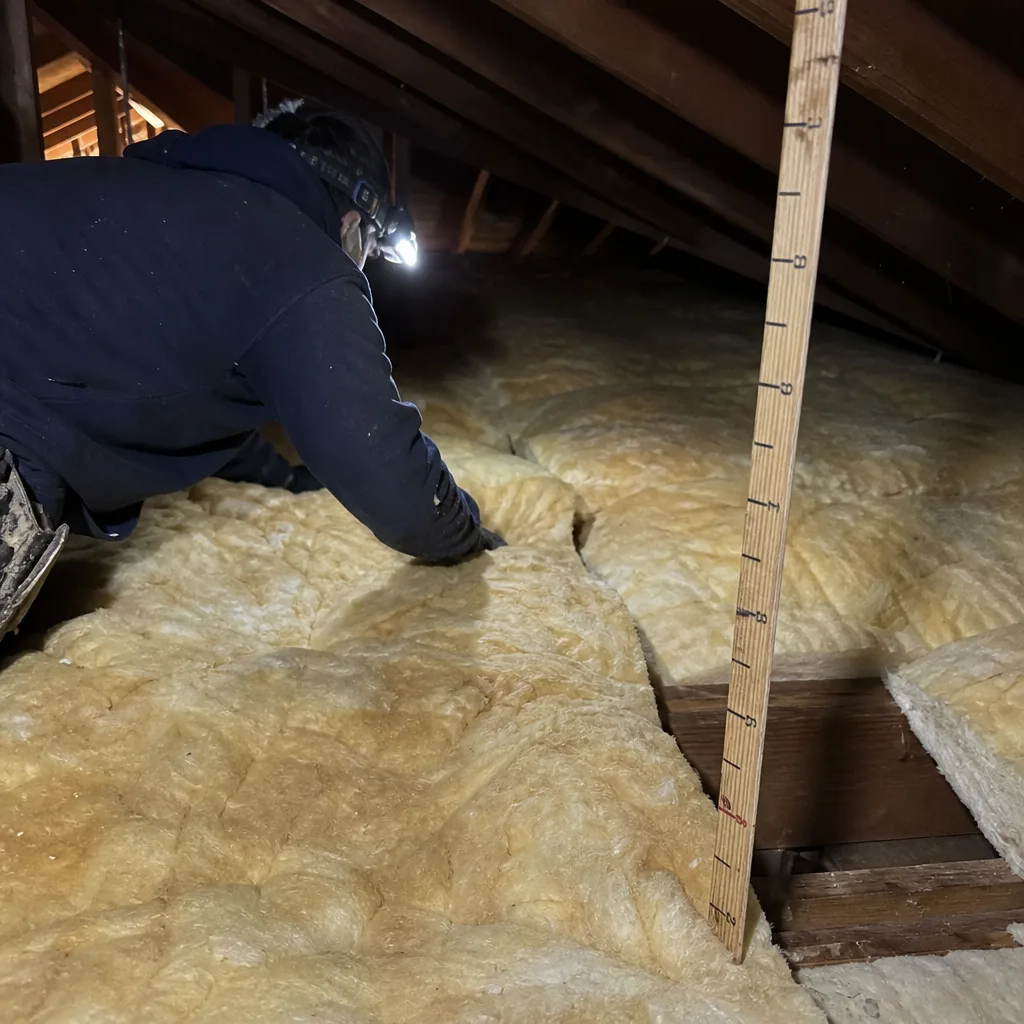
- Depth at the eaves versus depth at the center. Use a yardstick or tape measure. Push straight down until you hit drywall or plaster. Record three measurements: 2 feet from the windward eave, attic center, 2 feet from the leeward eave. In Long Beach’s typical northeast Santa Ana pattern, the southwest eave will be deepest. A 3-inch or greater difference indicates wind displacement.
- Exposed top plates or drywall. Where insulation has migrated, you may see the wood framing of the top plate or the ceiling drywall itself. These are thermal bypasses - direct paths for heat transfer that bypass the insulation entirely.
- Insulation in the soffit vents. Displaced loose-fill often falls through or is blown into soffit vents, blocking attic ventilation and creating moisture traps. Shine a flashlight into your soffits from outside, or check from inside the attic where the soffit meets the roof deck.
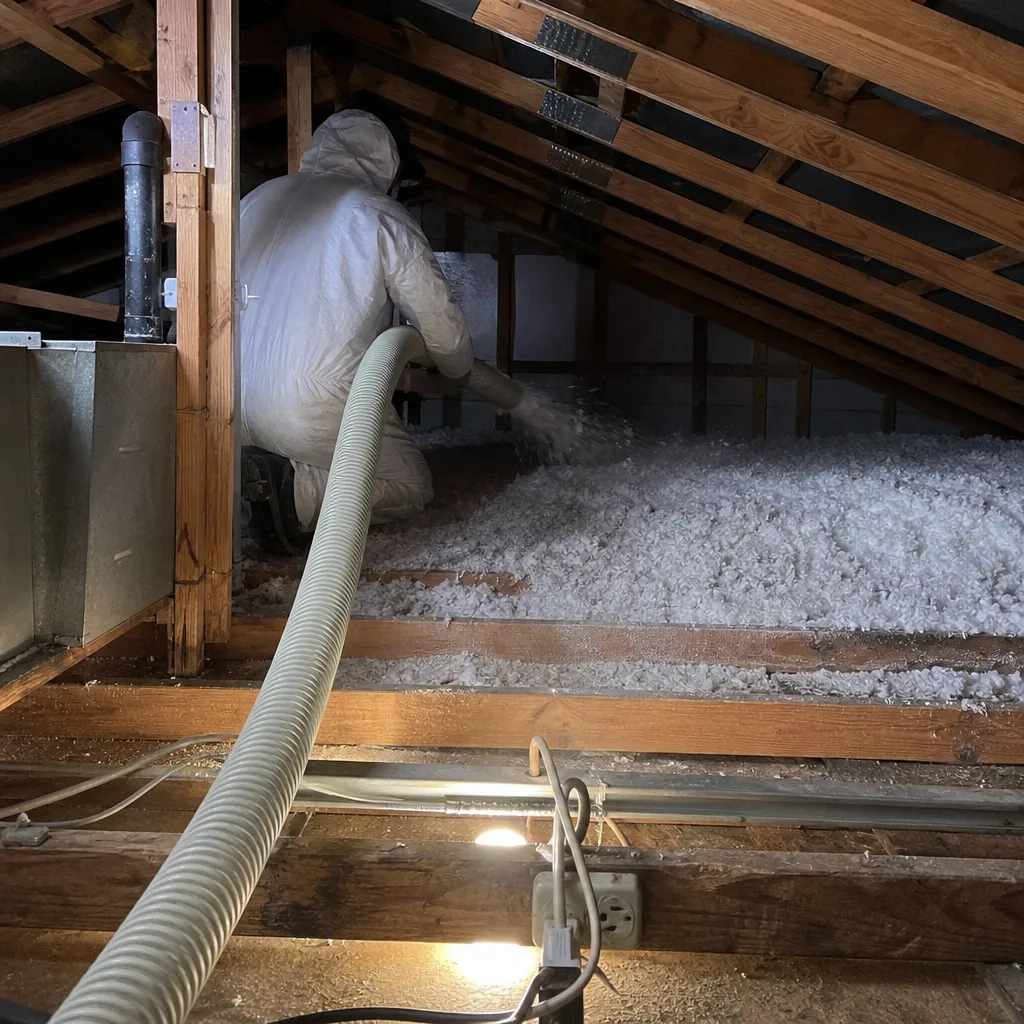
Prevention: we install baffles - cardboard or foam channels that maintain a ventilation gap from soffit to ridge - on every job that involves loose-fill over a vented attic. But baffles alone don’t stop displacement. The real fix is air sealing the attic floor to reduce the pressure differential that drives the movement. When we seal and insulate Long Beach homes, we target a blower-door reduction of 30-50% before adding insulation. Less air moving through the attic means less force acting on the loose-fill.
For homes in the Bluff Park or Bluff Heights areas, where original construction is 1920s-1940s with minimal eave overhangs, Santa Ana displacement is often worse. Small attics, complex rooflines, and original lath-and-plaster ceilings create more pressure variation. We’ve documented cases where the effective R-value dropped by 40% after a single wind event because insulation concentrated in corners and left valleys bare.
Cool-Wet Winter (December-February): Tracing Water Before It Wicks
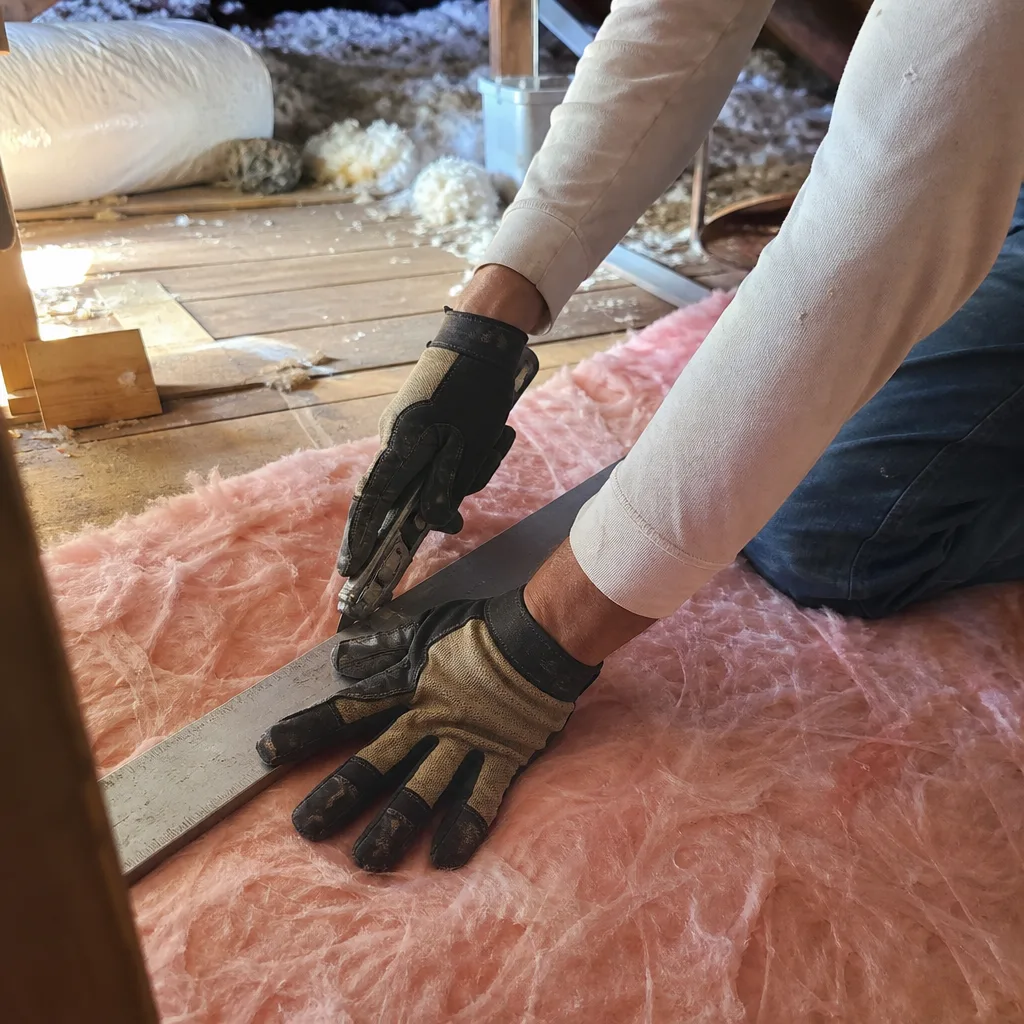
Long Beach’s rainy season is short but intense when it arrives. December through February brings Pacific storm systems with sustained rain and, occasionally, convective cells that dump water faster than older drainage can handle. For attic insulation, the critical window is 24-72 hours after rainfall - the time it takes for water to find a penetration, travel along framing or sheathing, and wick into insulation.
Wet insulation is failed insulation. Fiberglass loses 40-60% of its R-value when saturated. Cellulose, treated with borate fire retardant, can hold moisture without immediate mold but compresses permanently and settles faster. Spray foam, properly installed, is hydrophobic - but improper mixing or application gaps can create hidden reservoirs.
Post-rain inspection protocol:
- Start at the attic access during or immediately after rain. Look for active dripping, stained insulation, or water on the attic floor. Active leaks are emergencies; mark the location and trace uphill to the penetration.
- Follow the framing uphill from any stain. Water travels along rafters and top plates before dropping. The drip point is rarely the leak point. In Long Beach’s older neighborhoods, we’ve found leaks originating at chimney saddles or vent pipe flashings and traveling 8-10 feet along a rafter before showing.
- Check insulation at all penetrations. Plumbing vents, electrical service masts, and former fireplace chimneys are the most common leak paths. Insulation near these should be dry and uncompressed. If it’s stained or crusted with mineral deposits from repeated wetting, the leak is chronic, not new.
- Inspect the ridge and valleys for daylight. In daylight, with the attic lights off, look for pinholes of light at the ridge or in valleys. Each is a potential leak path. In Long Beach, where many homes have original clay tile or aging composite shingles, displacement from Santa Ana winds often cracks tiles or lifts shingles at the ridge, creating entry points that winter rain exploits.
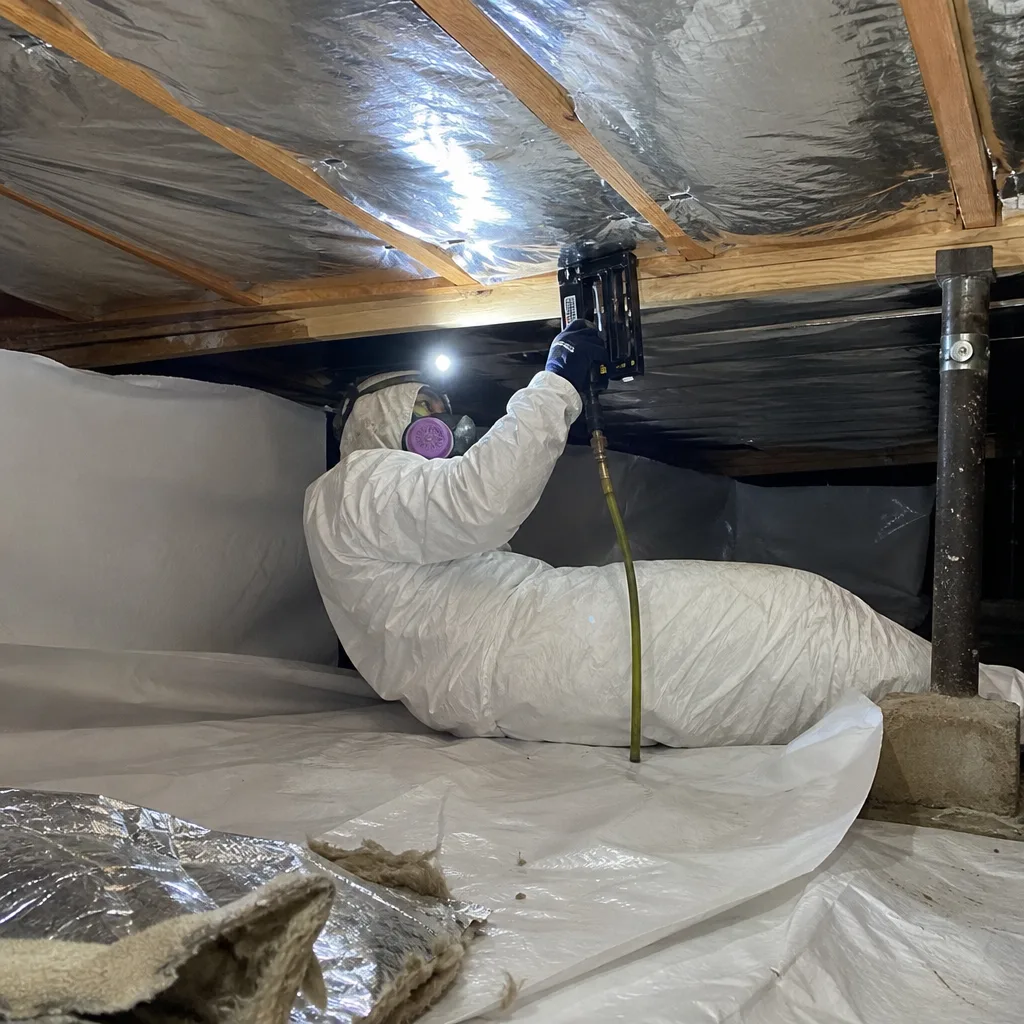
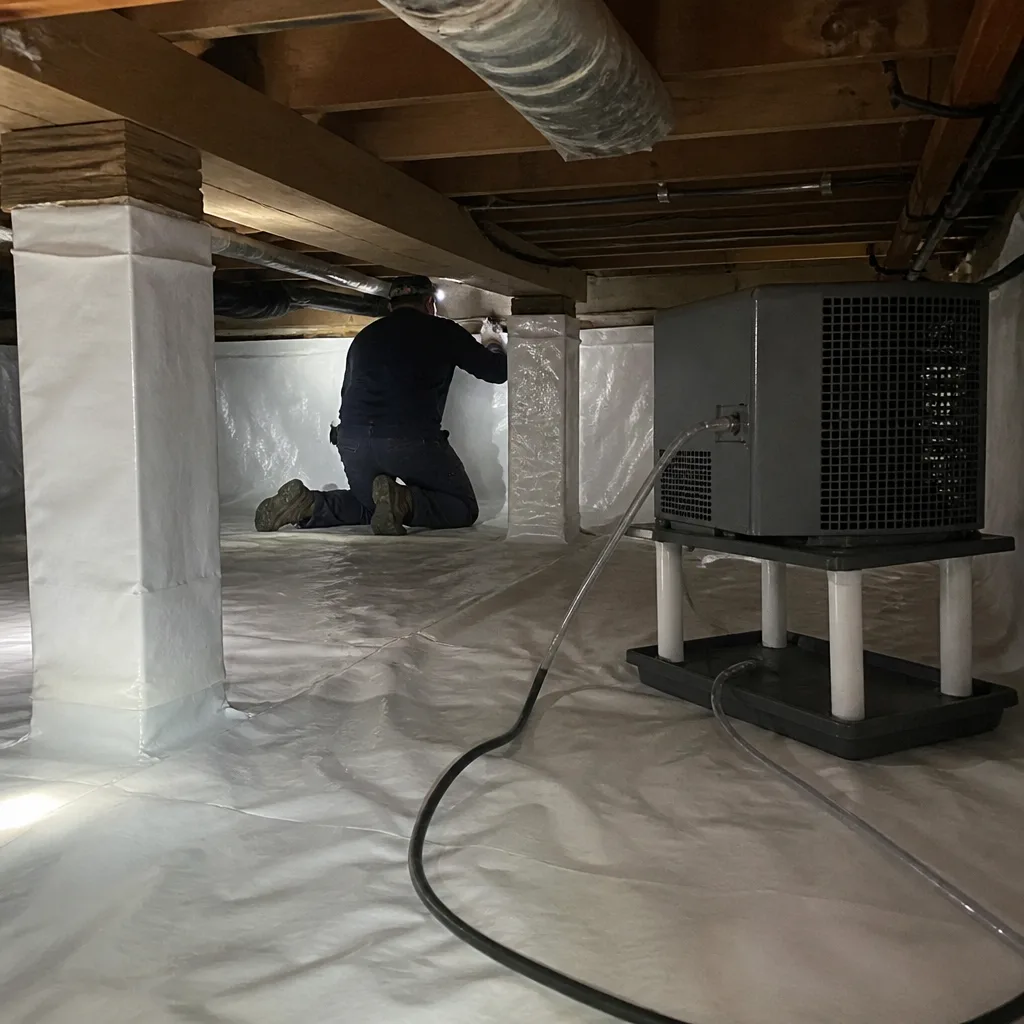
Crawl space encapsulation and vapor barrier in Long Beach is the parallel concern for homes with raised foundations, common in Belmont Shore, Naples, and the Peninsula. Winter rain saturates perimeter soil, and without a vapor barrier, that moisture evaporates into the crawl space, raising humidity that can migrate upward through the floor assembly. We encapsulate with 10-mil or thicker reinforced polyethylene, sealed at seams and perimeter, with conditioned-air supply or dehumidification as needed. The homeowner receives before-and-after photos and, on applicable jobs, moisture meter readings documented in the photo record.
One Long Beach-specific factor: the city’s aging storm drain infrastructure. In heavy rain events, street flooding in low-lying areas can back water against foundation vents. If your crawl space has unscreened or damaged vents, this is a direct water intrusion path. Our rodent-proofing work includes vent screening with 1/4-inch hardware cloth, which also blocks debris and reduces flood-driven water entry.
How to Keep a Seasonal Log That Actually Matters
Most energy-saving advice asks you to “track your usage” without specifying what, how, or why. Here’s a system we’ve refined based on what actually predicts problems in Long Beach’s climate. Three data points, recorded four times yearly, aligned to the climate modes above. After three years, you have a performance history that no single inspection can match.
The three data points:
- Utility kWh for the billing period. From your SCE bill, record total kWh and average daily kWh. Don’t use dollars - rates change. kWh is the constant.
- HVAC runtime hours for the same period. From your thermostat or condenser meter. If you have gas heat, record furnace runtime too; most modern furnaces track this.
- One attic depth measurement. At a fixed location you can find consistently - we recommend a marker string tied to a truss 4 feet from the access hatch, not at the hatch itself. Measure to the nearest half-inch.
Recording schedule:
- Early May: After marine layer season, before summer cooling loads. Captures moisture effects on insulation performance.
- Early October: After summer, before Santa Ana season. Captures baseline before wind displacement.
- Early December: After first Santa Ana events, before winter rains. Captures wind displacement if it occurred.
- Late February: After rainy season, before spring warming. Captures any water intrusion or compression from winter.
What the log reveals:
- kWh up, runtime up, depth unchanged: likely duct leakage or HVAC efficiency decline. Call for a duct-blaster test or system tune-up.
- kWh up, runtime unchanged, depth unchanged: rate change or non-HVAC load increase. Not an insulation problem.
- kWh up, runtime up, depth decreased: insulation degradation or displacement. Time for professional assessment.
- kWh flat, runtime flat, depth decreased: insulation has settled or shifted but weather has been mild. Address before next extreme season.
We provide a simple log template to homeowners who request it, no obligation. Under Haven Standard: Have it in writing - your data belongs to you, and it should be organized so you can use it.
Common Mistakes to Avoid
- Checking depth only at the access hatch. This is the most common error we see in Long Beach. The hatch area is disturbed by foot traffic, often re-lofted during previous inspections, and rarely representative of eave conditions. Measure at eaves, center, and hatch.
- Adding insulation over unsealed air leaks. Blowing new fiberglass or cellulose over a leaky attic floor is like adding a thicker sweater with the zipper down. We remove existing insulation and seal first on every job. No exceptions.
- Ignoring the marine layer as a moisture source. Homeowners in drier inland climates are told attics are dry. In Long Beach, they’re often not. Vapor-open assemblies without proper air sealing accumulate moisture at the sheathing.
- Replacing insulation without identifying the water source. We’ve been called to homes in the Plaza area where insulation was replaced three times in five years, each time after staining, with no one tracing the actual roof leak. The fourth call should have been the first.
- Assuming spray foam solves everything. Closed-cell spray foam is excellent when specified correctly, but improper thickness ratios, missed substrate preparation, or application in unvented assemblies without conditioned-air management can create new problems. We use Owens Corning, Johns Manville, Knauf, and other materials based on what the assembly needs, not what we stock.
- Skipping the crawl space. In raised Long Beach homes, the crawl space is half the envelope. Moisture there affects the whole house. Encapsulation with a proper vapor barrier is often the higher-ROI upgrade than additional attic insulation.
- Trusting verbal estimates without written scope. This isn’t specific to insulation, but it’s epidemic in the trade. A price without a written scope, material specification, and warranty document is not a price. It’s a starting point for change orders.
When to Call a Professional
Some conditions require trained assessment and shouldn’t be DIY projects. Call for professional evaluation if you find: active water dripping or saturated insulation; a depth gradient greater than 3 inches between eaves and center after wind events; visible mold on sheathing or framing; rodent droppings or compressed insulation trails indicating infestation; or knob-and-tube wiring in contact with or buried in insulation. These involve safety hazards - electrical fire risk, structural moisture damage, or airborne contaminants - that need documented assessment before remediation.
Topside Attic Insulation Long Beach offers free estimates in Long Beach. Every estimate includes a written scope, flat price, and material specification before any work is proposed. Call (424) 415-7031 to schedule. A live person answers 24/7.
Frequently Asked Questions
Most attic insulation jobs in Long Beach run between $2,800 and $6,500 for a typical 1,200-2,000 square foot home, depending on existing insulation condition, accessibility, and whether air sealing is needed first. Jobs requiring full removal of contaminated insulation, rodent proofing, and replacement start higher. We provide a written price before any work starts, always, with no obligation. Call (424) 415-7031 for an exact quote - estimates are free.
Insulation can be repaired or supplemented only if it’s dry, uncontaminated, and properly installed originally. Wet, moldy, or rodent-compromised insulation must be removed - it cannot be sanitized in place. Displaced loose-fill can be re-lofted and supplemented if the air leaks that caused displacement are sealed first. We assess this on every job and document what we find with photos before recommending action.
Long Beach is in Climate Zone 3B - dry, warm summers, mild winters - where the current California Energy Code recommends R-38 to R-49 in vented attics. But depth alone doesn’t tell the story. A home with R-38 at the hatch and R-15 at the eaves due to wind displacement is underperforming. We measure at multiple points and provide a blower-door test on applicable jobs to quantify actual envelope performance, not just theoretical R-value.
Three factors dominate in this market: Santa Ana wind displacement of loose-fill, moisture cycling from marine layer humidity that reduces fiberglass loft, and roof leaks that permanently compress cellulose. Vibration from LAX flight paths in northern Long Beach neighborhoods has also been implicated in gradual settling over decades, though this is secondary to weather factors.
It depends on the assembly. Closed-cell spray foam excels at air sealing and moisture resistance, making it appropriate for unvented attic conversions or homes with chronic duct leakage in conditioned attics. Fiberglass and cellulose, properly installed with thorough air sealing first, perform excellently in vented attics at lower cost. We specify materials - including GreenFiber cellulose, Icynene open-cell foam, or Demilec closed-cell - based on what the home needs, not a default product.
A single Santa Ana event can displace enough loose-fill to increase cooling load measurably within one billing cycle. Moisture intrusion from a winter leak can degrade R-value within 48 hours of saturation. Gradual settling from humidity cycling takes 2-3 years to show clearly in usage data. This is why the seasonal log matters - it catches gradual changes before they become obvious on the bill.
The Bottom Line
Long Beach’s climate doesn’t fit seasonal checklists designed for four distinct weather quarters. Marine layer humidity, Santa Ana wind displacement, dry summer heat, and concentrated winter rain each stress your insulation and air barrier differently. Inspect for moisture at the sheathing in spring, track HVAC runtime in summer, check for wind-shifted loose-fill at eaves in fall, and trace water paths after winter rain. Record three numbers four times yearly. After three years, you’ll know your home’s envelope better than any single inspection can tell you. And when you need professional assessment, you’ll have data that makes the diagnosis faster and the solution more precise. For ongoing care, explore our more guides & resources.
Written by Wes Okafor, Owner at Topside Attic Insulation Long Beach, serving Long Beach since 2016.