
Crawl Space Vapor Barrier in Long Beach, CA
A crawl space vapor barrier is a thick polyethylene sheet – typically 12 to 20 mil – that covers the soil floor and lower foundation walls of your crawl space, blocking ground moisture before it can migrate upward into your floor framing, subfloor sheathing, and living space. Most Long Beach homes with crawl spaces that show visible condensation, soft flooring, or a musty odor need one. At Topside Attic Insulation Long Beach, Wes Okafor and our crew have installed vapor barriers in crawl spaces across Long Beach since 2016, and every job starts with a written price before any material touches your foundation wall.
Long Beach sits in a coastal marine climate where nighttime relative humidity regularly climbs above 80 percent from May through September. That moisture doesn’t stay outside. Soil under a crawl space holds ground water long after rain, and in neighborhoods like Bixby Knolls, Wrigley, and the older Craftsman blocks near Retro Row, crawl spaces in homes built between the 1920s and 1960s often have bare-dirt floors with no barrier at all. The result: ground moisture evaporates upward, condenses on cold joists, and starts the wood-rot and mold cycle that eventually shows up as a soft spot in your kitchen floor or a musty smell that no amount of air freshener fixes.
This page focuses specifically on vapor barrier installation as a standalone service. If you’re considering full encapsulation – sealed vents, wall liner, drainage, and conditioned air – our Crawl Space Encapsulation & Vapor Barrier in Long Beach page covers the complete scope. And if you’d like to start from the top, our home page outlines every building-envelope service we provide.
To get a written price without committing to anything, call us at (424) 415-7031. A live person picks up – no voicemail, no callback window.
When You Need a Crawl Space Vapor Barrier
Not every Long Beach crawl space is in crisis. But certain signs mean ground moisture is already doing damage, and a vapor barrier is the first corrective step.
- Visible condensation on floor joists or subfloor sheathing. If your joists look wet or have a white mineral bloom (efflorescence) on the concrete piers, ground moisture is the most likely source. In Long Beach’s coastal zip codes – 90802, 90803, 90814 – this is especially common in spring and early summer when soil temperatures lag behind warming air.
- A persistent musty or earthy smell inside the house. Crawl space air rises into living space through gaps in the subfloor. If the smell is stronger near baseboards or floor registers, the odor is almost certainly crawl-space origin, not a plumbing issue.
- Soft, spongy, or bouncy flooring. Subfloor plywood absorbs moisture before it fails visibly. By the time a floor feels soft underfoot, the panel has often lost significant structural stiffness. A vapor barrier won’t reverse that damage, but it stops the source so repairs hold.
- Standing water or damp soil after rain. Long Beach averages roughly 13 inches of rainfall per year, most of it between November and March. Homes in lower-lying areas near the Los Angeles River floodplain – parts of North Long Beach and the Poly High neighborhood – can see standing crawl space water after a wet January. A barrier alone isn’t enough if drainage is the root problem, and we’ll tell you that plainly during the inspection.
- Mold spotted on insulation batts or wood framing. Fiberglass batts stapled to joist bays hold moisture and become mold substrate when ground vapor is present. If you’re seeing dark staining or fuzzy growth, the insulation needs to come out before a barrier goes in – and we document the condition with photos before any work starts.
- Pest activity or prior rodent evidence. Rats and mice colonize crawl spaces that are damp and unprotected. A vapor barrier combined with proper exclusion work removes the habitat conditions that attract them. We work in crawl spaces regularly enough to spot the difference between active harborage and old evidence, and we’ll note it in writing either way.
Our Crawl Space Vapor Barrier Process
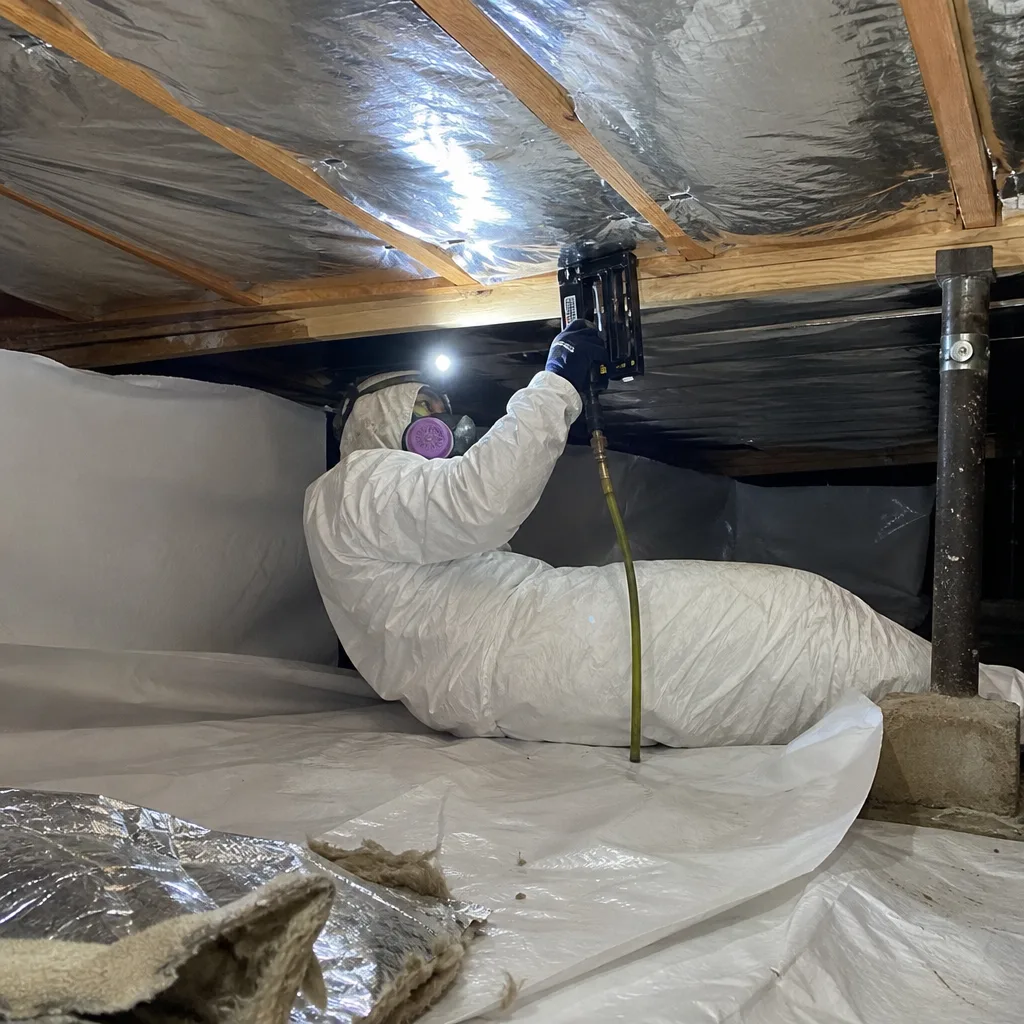
The sequence below is how we actually work – not a marketing summary of steps. Skipping any of these produces a barrier that fails within a few seasons, which is why we don’t skip them.
- Written scope and price delivered before entry. Under Haven Standard Clause 1, you receive a flat written price and written scope before anyone goes under your house. The scope specifies the mil thickness of the barrier, the square footage to be covered, how seams will be lapped and taped, how the liner will terminate at the foundation wall, and whether any existing material needs to be removed first. No vague estimates that expand on the job.
- Crawl space inspection and photo documentation. Our technician photographs the existing condition – soil, joists, piers, any standing moisture, existing insulation, and any visible mold or pest evidence. These photos are yours. They’re the baseline record that shows what we found, not what we felt about it. We also note ventilation configuration, because passive vents that draw moist ocean air directly in during Long Beach’s June marine layer season can counteract a well-installed barrier if they’re left unaddressed.
- Debris clearance and grade preparation. Rocks, construction debris, old insulation, and any standing moisture get removed. The soil surface doesn’t need to be perfectly level, but sharp objects puncture liners, and we don’t leave hazards under a new barrier. If we find evidence of prior rodent activity, we document it and discuss remediation options before proceeding – we don’t bury a problem under plastic.
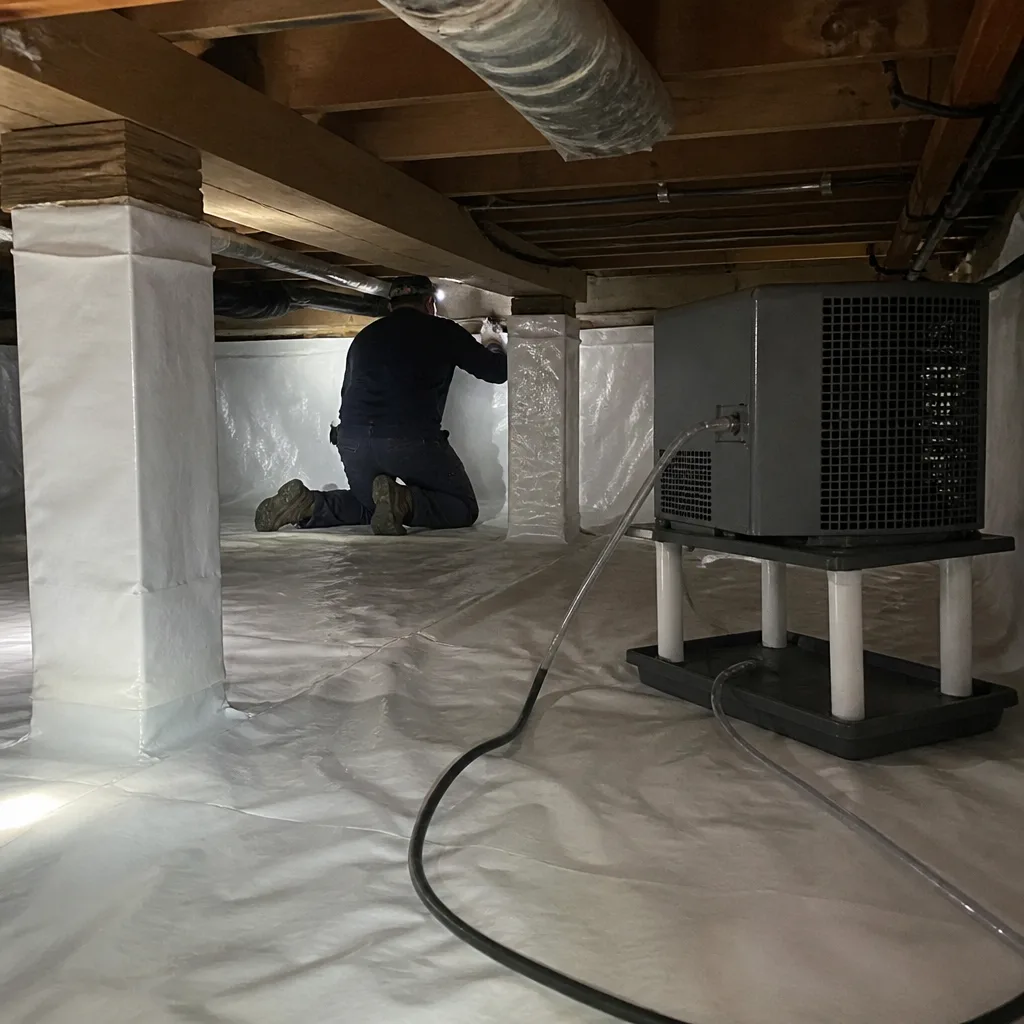
- Vapor barrier installation. We install a 12-mil minimum polyethylene liner – heavier gauge on jobs where crawl space access is frequent or soil conditions are rough. Sheets are lapped a minimum of 12 inches at seams and sealed with a compatible tape. The liner runs up and is mechanically fastened to the foundation wall, typically 6 to 12 inches above the soil line. Piers and columns get wrapped individually so the barrier forms a continuous surface, not a collection of floor patches. For Long Beach homes near the coast where soil salinity is higher, we confirm the tape adhesive is rated for that environment – tape failure at the seam is the most common reason barriers underperform within two years of installation.
- Penetration sealing around pipes and posts. Every pipe, post base, and wire penetration through the liner gets sealed. This is where shortcuts show up: an unsealed pipe penetration is a direct path for ground moisture to bypass the entire barrier system. We treat penetrations the same way we treat top-plate penetrations in attic air sealing – close every opening before calling the field work done.
- Documented close-out with photos. When the crew leaves, you get a photo record of the completed installation – seams, wall termination, pier wraps, and penetration seals. The 365-Day Done Right Promise applies to the completed work: if anything fails or is found to be deficient within 365 days, we make it right. That’s in writing before we start, not offered after a complaint.
Crawl Space Vapor Barrier Pricing in Long Beach
Vapor barrier installation in Long Beach typically runs between $1,200 and $4,500 for most residential crawl spaces, with the majority of single-family homes falling between $1,500 and $2,800. See How Much Does Crawl Space Encapsulation & Vapor Barrier Cost? (2026 Price Guide) - Long Beach, CA for a detailed breakdown. The wide range reflects real variables – not guesswork designed to get you on the phone.
| Factor | Typical Range or Impact |
|---|---|
| Crawl space square footage (material + labor) | $1.50 – $3.50 per sq ft installed |
| Barrier mil thickness (12 mil vs. 20 mil) | 20-mil adds $0.40 – $0.70 per sq ft |
| Existing insulation removal required | $300 – $900 depending on coverage area |
| Crawl space height and access difficulty | Low-clearance jobs (under 18 in.) add $200 – $500 |
| Number of piers and penetrations to wrap/seal | $15 – $35 per penetration sealed |
| Debris or standing-moisture clearance | $150 – $400 depending on volume |
A few things that don’t affect your written price: how many questions you ask before signing, whether you want to see the photo record during installation rather than at the end, or whether you bring us a competing written estimate and ask us to go through it line by line. That’s included under our Free Second Opinion on any written estimate – we’ll read it with you and tell you what we see, without charging for the time or pressuring you to switch.
Long Beach permit requirements for crawl space vapor barriers are generally limited to projects that include vent sealing or conditioned air supply as part of full Crawl Space Insulation and encapsulation. A standalone vapor barrier installation typically does not require a permit in the City of Long Beach, but we confirm the current code requirement for each project and include that confirmation in your written scope. If a permit is needed, we handle the filing and include the cost in your flat price – no permit surprises after the fact.
Call (424) 415-7031 and we’ll schedule an on-site inspection to give you a written price. There’s no obligation to proceed.
FAQs – Crawl Space Vapor Barrier
How thick should a crawl space vapor barrier be in Long Beach?
For most Long Beach homes, a 12-mil polyethylene liner is the minimum we’d recommend, and we typically install 20-mil on any crawl space where someone will need to access the space regularly for plumbing or HVAC work. California Building Code section 1202.4 references a minimum 6-mil barrier for ground cover in crawl spaces, but 6-mil tears easily during and after installation, and we’ve seen plenty of six-mil jobs in Belmont Shore and Rose Park that were riddled with tears within two seasons of foot traffic. Thicker liner costs more upfront; it doesn’t need to be replaced or patched every few years. Your written scope will name the mil thickness explicitly so there’s no confusion on the day of installation.
Will a vapor barrier alone fix my moisture problem, or do I need full encapsulation?
A vapor barrier alone is sufficient when the primary moisture source is ground evaporation and your crawl space vents are either well-configured or can be adjusted without major work. Full Crawl Space Encapsulation & Vapor Barrier services – sealed vents, conditioned air, complete wall liner – makes sense when you’re also dealing with significant air infiltration from outside, high radon levels, or a crawl space you want to use for storage. During the inspection, we document what we find and tell you plainly which scope fits the actual problem. We don’t upsell encapsulation on a crawl space that a barrier will solve. Call (424) 415-7031 to schedule the inspection.
How long does crawl space vapor barrier installation take?
Most single-family crawl spaces in Long Beach – the kind you’d find under a 1,200 to 1,800 square foot Craftsman or postwar bungalow – take four to eight hours for a two-person crew to complete, including debris clearance, liner installation, seam taping, penetration sealing, and photo documentation. Larger homes, very low-clearance spaces, or crawl spaces requiring significant debris removal can run a full day. Your written scope will include a time estimate, and you’ll get a text when the technician is on the way so you’re not holding your schedule open all morning.
Does Topside Attic Insulation Long Beach remove old vapor barriers before installing new ones?
Yes, always. Installing new liner over old, degraded polyethylene traps moisture between layers and prevents the new barrier from seating flat against the soil. Old material that’s torn, mold-contaminated, or was originally installed at inadequate thickness comes out before any new liner goes down. The removal cost is listed as a separate line item in your written price – you see exactly what you’re paying for clearance versus installation. We photograph the old material before pulling it so you have a record of the prior condition.
Why Long Beach Crawl Spaces Need This More Than You Might Think
Long Beach is unusual for a Southern California city in that a significant portion of its housing stock predates the postwar boom. Large sections of Wrigley, Zaferia, and the blocks east of Anaheim Street contain homes from the 1920s through early 1940s – buildings where the original crawl space design assumed cross-ventilation would handle moisture. That assumption worked better in drier decades. Today, the combination of coastal humidity, denser plantings around foundations, and the urban heat island effect around the Port of Long Beach and downtown creates a moisture environment that passive venting alone doesn’t manage.
We’ve also seen a specific issue in Long Beach homes with original cast-iron drain lines under the slab or in the crawl space: when those lines develop slow leaks, the soil moisture content climbs and the vapor drive upward increases. A vapor barrier doesn’t fix the leak, but it contains the moisture migration while plumbing repairs are scheduled. That’s a situation where we’ll document the evidence, flag the likely plumbing issue in writing, and proceed with the barrier as a protective measure – not as a permanent solution to a plumbing problem.
Materials we use are sourced from established manufacturers including Owens Corning and similar tier-one suppliers. We don’t use proprietary products that lock you into one vendor for repairs or extensions – the liner and tape we install are commercially available, which means any qualified contractor can inspect or add to the work down the line. That’s by design.
Wes Okafor and the team at Topside Attic Insulation Long Beach have completed vapor barrier work in Long Beach neighborhoods including Bixby Knolls, Cambodian District, California Heights, Signal Hill-adjacent properties, and along the corridors near Cherry Avenue and PCH where the soil profiles and drainage characteristics vary enough to require site-specific decisions. No two crawl spaces are the same, which is why the inspection and photo documentation happen before any price is finalized – not after.
Key Takeaways
- A crawl space vapor barrier in Long Beach typically costs $1,200 to $4,500, depending on square footage, mil thickness, and site conditions.
- We install a minimum 12-mil liner; 20-mil is standard for frequently accessed crawl spaces.
- Every job starts with a flat written price and ends with a documented photo record – Haven Standard, no exceptions.
- Old barrier material is always removed before new liner is installed – we don’t layer over a failed system.
- Long Beach’s coastal humidity and older housing stock make vapor barriers a practical necessity in many pre-1960 homes, not an optional upgrade.
- The 365-Day Done Right Promise applies: if it isn’t right, we make it right.
Get a Written Price for Your Long Beach Crawl Space
If you’re seeing moisture signs, smelling that crawl-space odor, or just want to know what’s under your house before it becomes a bigger problem, call Topside Attic Insulation Long Beach at (424) 415-7031. We’ll schedule an inspection, document what we find, and give you a written price before any work is discussed further. If you have a competing written estimate, bring it – we’ll go through it with you at no charge. A live person answers that number around the clock.
Written by Wes Okafor, Owner at Topside Attic Insulation Long Beach, serving Long Beach.