
Insulation Before & After in Long Beach, CA
Photos don’t exaggerate. A blower-door test gives you a number; a thermal camera shows you a gradient; but a before-and-after photo gallery lets you see what “sealed first, then insulated” actually looks like in a Long Beach attic or crawl space. We’ve documented every job since 2016 - over 9,000 homes - and these are the transformations that stick with us.
Recent Transformations
Attic Insulation Removal & Replacement - Belmont Shore
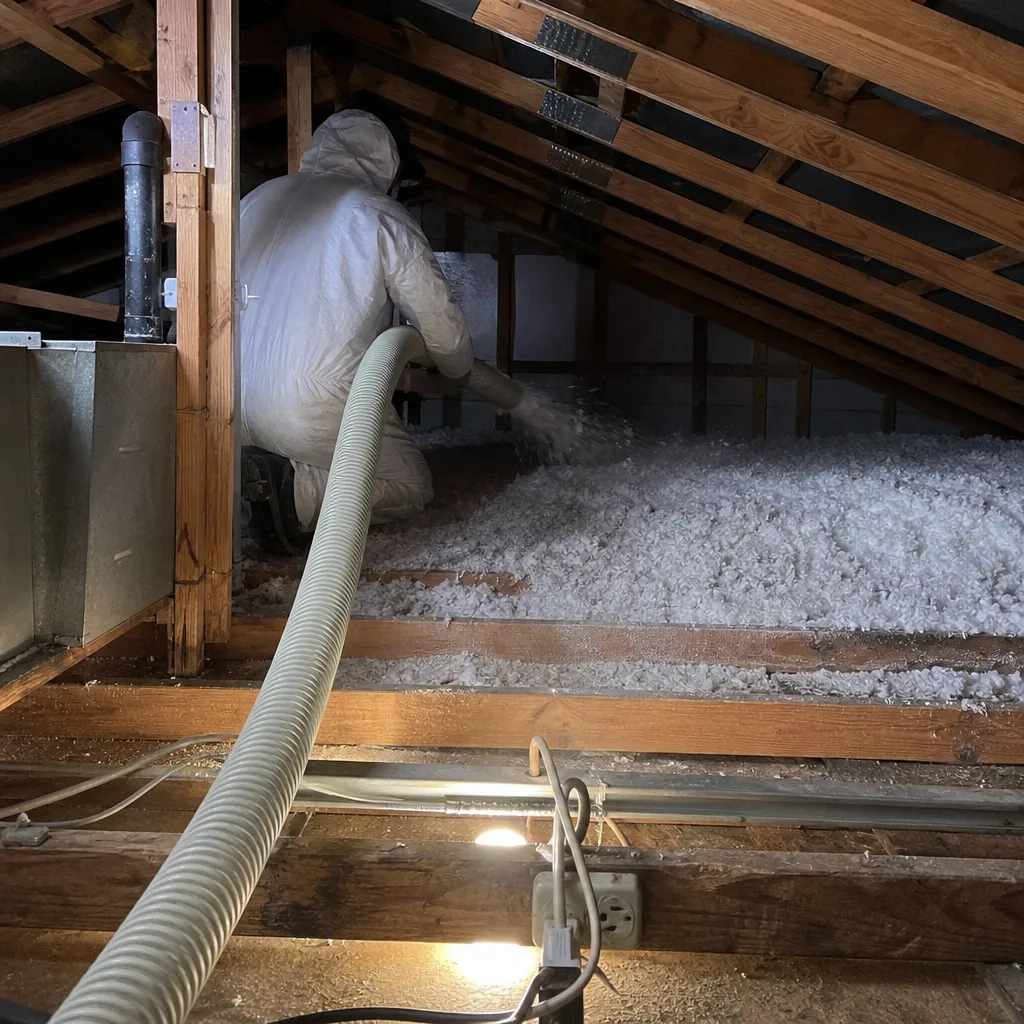
The homeowner in Belmont Shore had owned the 1947 bungalow for eleven years and assumed the original insulation was “fine, just old.” What we found was R-19 batt compressed to roughly R-10 effective value, with visible gaps at the eaves where conditioned air was bleeding into the roof deck. We removed the degraded material, sealed the top plates and can-light penetrations, then installed blown-in fiberglass to a full R-38 depth. The blower-door test read 3,800 CFM50 before sealing and 2,100 after - a 45% reduction in envelope leakage. The written scope, the photo record, and the before-and-after numbers went into a folder the homeowner still has.
Crawl Space Encapsulation & Vapor Barrier - Bixby Knolls
Bixby Knolls sits on some of the most moisture-retentive soil in Long Beach, and this 1952 ranch had the classic symptoms: musty first-floor air, cupping hardwood, and a crawl space that smelled like a basement that had given up. We found exposed soil, standing water after rain, and mold-stained joists. Our crew installed a 12-mil reinforced vapor barrier sealed at all seams, closed and sealed the foundation vents, and ran a dehumidifier drain line to the exterior. The relative humidity in the crawl space dropped from 78% to 52% within 48 hours. Under Haven Standard, the homeowner got the written scope beforehand, the photo record after, and a 365-Day Done Right Promise on the encapsulation.
Spray Foam Insulation - Retrofit Wall Cavities - Naples
A full-gut renovation in Naples gave us access to wall cavities that hadn’t been open since 1963. The framing was honest - no rot - but the sheathing had gaps you could see daylight through, and there was zero insulation in the walls. We used closed-cell spray foam at 2 inches, which gave the homeowner R-14, an air barrier, and a vapor retarder in one application. The ACH50 dropped from 8.2 to 4.1 - meaning the house now exchanges its air volume roughly four times per hour under pressurization instead of eight. That’s the difference between a house that fights the Long Beach marine layer and one that ignores it.
Attic Air Sealing & Blown-In Top-Up - Signal Hill Adjacent
This 1978 split-level near the Signal Hill border had the usual suspects: gaps around the chimney chase, dropped soffits that acted as open conduits straight into the wall cavities, and a bath fan that had been dumping moist air into the attic for years. We don’t blow insulation over that. We sealed the chase with fire-rated foam and metal flashing, blocked the soffit drops with rigid foam and sealant, and vented the bath fan through the roof. Then we brought the blown-in cellulose to R-38. The crew documented every step - the photos show the pink foam around the chase, the blocked soffits, and the final even coverage. The homeowner got the folder, the numbers, and a written price that never changed.
Radiant Barrier Installation - Alamitos Heights
Alamitos Heights gets the afternoon sun full on the roof, and this 1986 two-story had a dark asphalt shingle roof deck that measured 148°F on a July afternoon. The attic air was 138°F. The HVAC ductwork was up there, fighting a battle it couldn’t win. We stapled perforated radiant barrier to the rafters - not the attic floor, which would have trapped moisture - and the roof deck surface temperature dropped to 112°F. Attic air temp fell 18°F. The ducts stopped sweating. The homeowner didn’t need more insulation; they needed less radiant heat gain, and the barrier gave it to them with a 15-year expected service life. The photo record shows the stapling pattern, the rafter spacing, and the temp gun readings.
Insulation Removal After Rodent Damage - Lakewood Village
The Lakewood Village homeowner called because the house smelled wrong - not musty, not gas, just wrong. We found rodent-compacted insulation with droppings, urine saturation, and tunnel runs through the fiberglass. That’s not a thermal barrier; it’s a biohazard. Our crew suited up, removed the contaminated material with HEPA containment, sanitized the deck and joists, and rodent-proofed every entry point with steel mesh - not spray foam, which they chew through. Then we sealed the envelope and installed new R-38 blown-in fiberglass. The smell left with the old insulation. The photo record includes the entry-point map, the mesh installations, and the final coverage. The 365-Day Done Right Promise covers the workmanship; the documentation covers everything else.
Want Results Like These?
Every job you see here started the same way: a phone call to a live person, a scheduled assessment, and a written price before any work started. No exceptions. If you’ve got a competing quote, bring it - we’ll read it with you. Call (424) 415-7031 and we’ll get you on the calendar. Wes Okafor, Owner at Topside Attic Insulation Long Beach, serving Long Beach since 2016.
Written by Wes Okafor, Owner at Topside Attic Insulation Long Beach, serving Long Beach since 2016.