
Attic Insulation Top-Up in Long Beach, CA
An attic insulation top-up adds a fresh layer of blown-in insulation over existing material that has settled, thinned, or aged below the level Long Beach homes need to perform. Most top-ups in this area bring the attic floor up to R-38 or R-49 - the range California’s Title 24 energy code targets for Climate Zone 6 - and the job is typically complete in a single visit. Before any insulation goes in, we seal the air leaks underneath it, because blowing new material over an unsealed attic floor traps the problem instead of solving it.
If you’ve noticed your energy bills climbing or rooms that never quite reach the temperature on the thermostat, the attic is the first place to look. Our Attic Insulation in Long Beach service covers the full scope, from full replacements to targeted top-ups like this one. To get a written price before any work starts, call us at (424) 415-7031 - a live person answers every time.
When You Need an Attic Insulation Top-Up
A top-up makes sense when the existing insulation is structurally sound but below the performance threshold the home needs. Here are the most common situations we find in Long Beach attics:
- Your existing insulation measures below R-19. R-19 is roughly 6 inches of blown fiberglass. Anything shallower than that in a Long Beach home means the attic is doing almost no thermal work during summer afternoons when exterior temperatures regularly hit the low 90s in neighborhoods like Bixby Knolls and Signal Hill.
- Rooms directly below the attic are consistently 5-8 degrees warmer than the rest of the house. In Long Beach’s older housing stock – the 1940s and 1950s bungalows in Wrigley and the postwar tracts near Cal State Long Beach – original insulation may have compressed to a fraction of its installed depth over decades.
- Your gas or electric bills spiked after 2020 without a lifestyle change. California energy rates have increased significantly since 2020. Insulation that was “adequate” in 2015 may no longer offset those rate increases at its current R-value.
- The insulation is intact but clearly settled and thin. Fiberglass batts compress over time. GreenFiber cellulose and blown fiberglass both settle at predictable rates. If we measure and the depth reads well below the original installed depth, a top-up recovers the lost R-value without a full tear-out.
- A recent energy audit flagged insufficient attic insulation as the primary heat-gain source. Our blower-door readings frequently show that attic air bypasses account for the largest share of conditioned-air loss in Long Beach homes built before 1980. A top-up paired with air sealing addresses both findings at once.
- You’ve just had HVAC work completed and the contractor found the ductwork was uninsulated or barely wrapped. New ductwork sitting in a poorly insulated attic loses capacity fast. Bringing the insulation up to code depth right after a duct replacement protects the investment.
Our Attic Insulation Top-Up Process
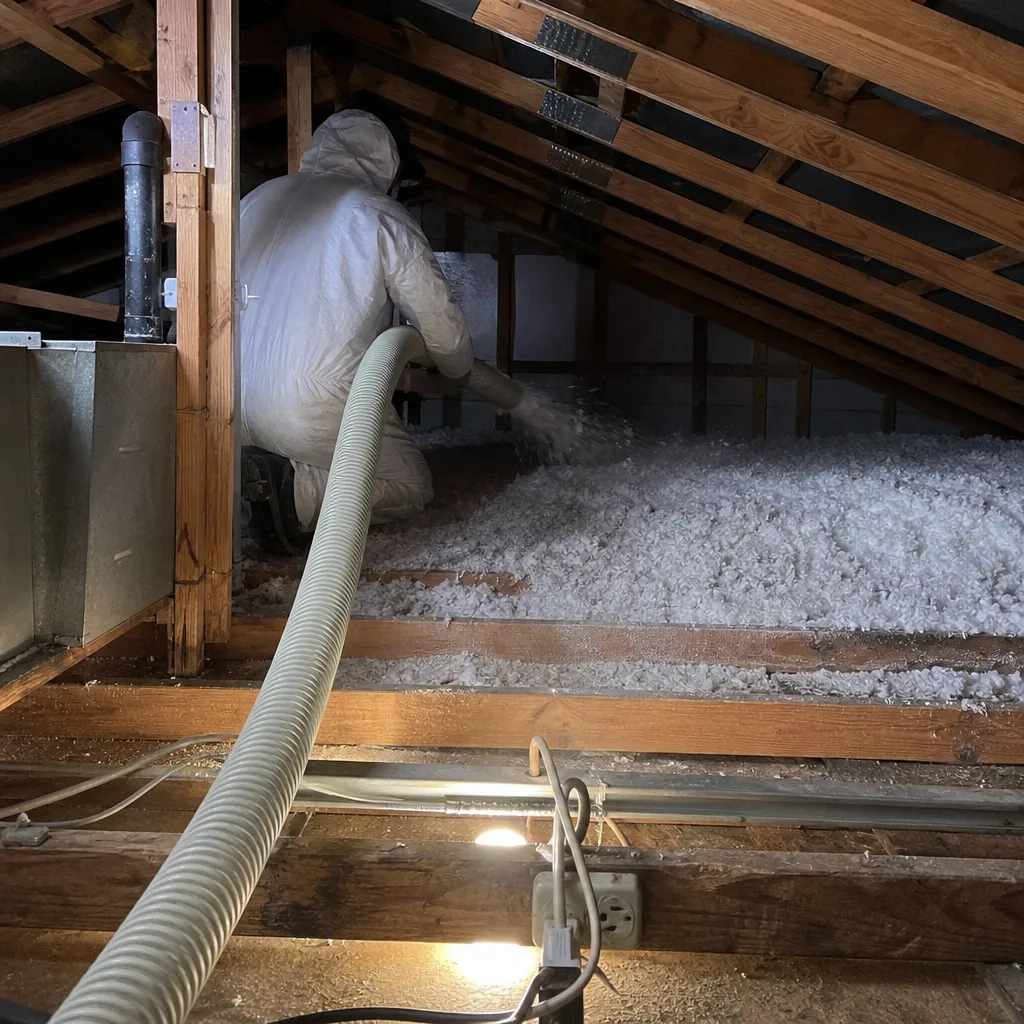
We don’t treat a top-up as a simple “blow and go” job. Every step below has a reason, and the order matters.
- Pre-job blower-door test and attic inspection. Before pricing or scheduling material, we run a blower-door test – a pressurization reading that gives us a single number showing how much conditioned air the home’s building envelope is losing. We record the CFM50 reading and photograph the existing insulation depth with a ruler in frame. That number and those photos are yours to keep. They also tell us whether air sealing is needed before the top-up, which, in our experience across 9,000+ homes sealed and insulated since 2016, it almost always is.
- Air sealing of top plates, recessed can lights, and penetrations. This step happens before a single bag of insulation is opened. We seal around top plates (the framing members where interior walls meet the attic floor), around any recessed light fixtures that penetrate the ceiling plane, and around plumbing and electrical penetrations. We use low-expansion spray foam and fire-rated caulk at each location. Skipping this step and blowing insulation over open bypasses is the single most common mistake we see from prior installations in Long Beach homes, and it’s why we treat air sealing as a prerequisite rather than an add-on. This is core to how Attic Insulation work is supposed to be done.
- Written price delivered before any insulation is installed. Under Haven Standard Clause 1, no work starts without a flat written price and written scope in your hands. The price you approve is the price on the invoice. There are no adjustments for “what we found up there.”
- Blown-in insulation installation to target depth. We install blown fiberglass or cellulose – typically Owens Corning or GreenFiber, depending on the existing material and the home’s specific needs – using depth markers placed at regular intervals across the attic floor so the install crew hits consistent depth throughout. For most Long Beach homes targeting R-38, that means roughly 12 inches of blown fiberglass or 10 inches of dense-pack cellulose. We don’t stop at “close enough.”
- Post-installation blower-door test. After the insulation is in, we run a second blower-door reading. The before and after numbers go into your documented record. On a well-executed top-up with proper air sealing, it’s normal to see a 20-35% reduction in CFM50 from the pre-job reading. We publish those numbers on the job record because the measurement is the proof, not a claim we make about how well we did.
- Documented photo record and written warranty. Before we leave, you receive a written warranty and a documented photo record of the completed work – depth markers visible, penetrations sealed, insulation level confirmed. That record is included on every job, not available on request. The 365-Day Done Right Promise applies: if it’s not done right, we make it right, in writing.
Attic Insulation Top-Up Pricing in Long Beach
Most attic insulation top-ups in Long Beach run between $900 and $2,800, depending on attic square footage, existing R-value, access conditions, and the extent of air sealing required. Here’s a more specific breakdown by scenario:
| Scenario | Typical Range |
|---|---|
| Small home (under 1,200 sq ft attic), modest top-up from R-19 to R-38, standard access | $900 – $1,400 |
| Mid-size home (1,200 – 1,800 sq ft attic), top-up from R-11 to R-38, air sealing included | $1,400 – $2,000 |
| Larger home (1,800 – 2,500 sq ft attic), deep top-up from below R-11, full air sealing | $1,800 – $2,800 |
| Attic with difficult access (low pitch, multiple HVAC units, limited hatch clearance) | Add $200 – $500 to any range above |
What moves the number up: very low existing R-value (more material required), attics with tight clearances common in Long Beach’s 1950s-era homes near Alamitos Heights, high can-light counts that require more air sealing labor, and attics that haven’t been cleaned and have debris mixed into the existing insulation.
What moves the number down: attics already at R-19 or above that just need a modest top, clear hatch access with no HVAC equipment in the path, and recently installed insulation that settled uniformly rather than patchily.
We don’t offer ballpark ranges over the phone without seeing the attic. The free estimate includes a written price, a documented inspection, and the pre-job blower-door reading. That’s the starting point for every Long Beach job we do. Call (424) 415-7031 to schedule yours – no obligation, no pressure, and you’ll have a number in writing before we ask you to decide anything.
If you have a written estimate from another contractor, bring it. We offer a free second opinion on any written estimate – we’ll read through it with you and tell you what we see.
What R-Value Does Long Beach Code Require?
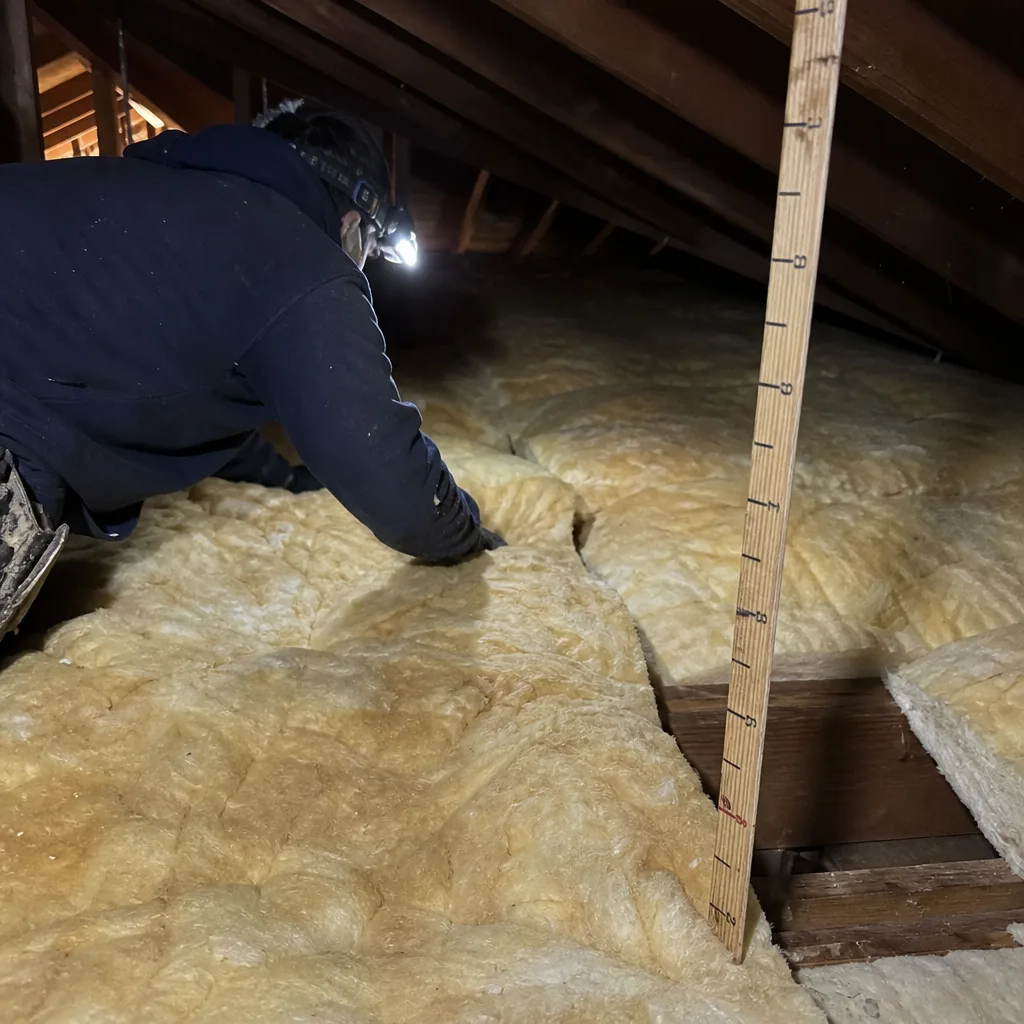
California’s Title 24 building energy code places Long Beach in Climate Zone 6. For existing homes undergoing insulation upgrades, the prescriptive requirement is R-38 at the attic floor. New construction in Climate Zone 6 is often held to R-49. During our inspection, we’ll measure your current depth and tell you exactly where you stand against both thresholds.
One thing Long Beach’s climate makes complicated: the marine layer. Coastal humidity in neighborhoods like Belmont Shore and Naples keeps attic temperatures more moderate than inland Southern California, which sometimes leads homeowners to underestimate heat gain through the roof deck. The temperature differential between a Long Beach attic and the living space below can still hit 30-40 degrees on a July afternoon, and under-insulated ceilings transfer that load directly to the HVAC system.
Why Air Sealing Comes First – Every Time
There’s a persistent belief that adding more insulation always helps, regardless of what’s underneath it. It doesn’t, not fully. Insulation slows the movement of heat through a material. It does almost nothing to stop air moving through a gap. A top plate gap the width of a quarter, running the full length of an interior wall, can move more conditioned air in a day than a poorly insulated wall section.
When we find those gaps in Long Beach attics – and in homes built before 1980, we find them on nearly every job – sealing them before the insulation goes in with proper ventilation prep and air sealing is what makes the top-up actually perform. This is why our blower-door numbers show measurable reductions after the work is done. The insulation alone wouldn’t produce that result.
We’ve seen other contractors blow insulation directly over open can lights, unsealed wiring chases, and open top plates. The homeowner gets an attic that looks insulated, but the conditioned air is still moving freely through the bypasses underneath. That’s work that has to be redone. We don’t do it that way, and the before-and-after blower-door readings we provide prove the difference.
Materials We Use for Top-Ups in Long Beach
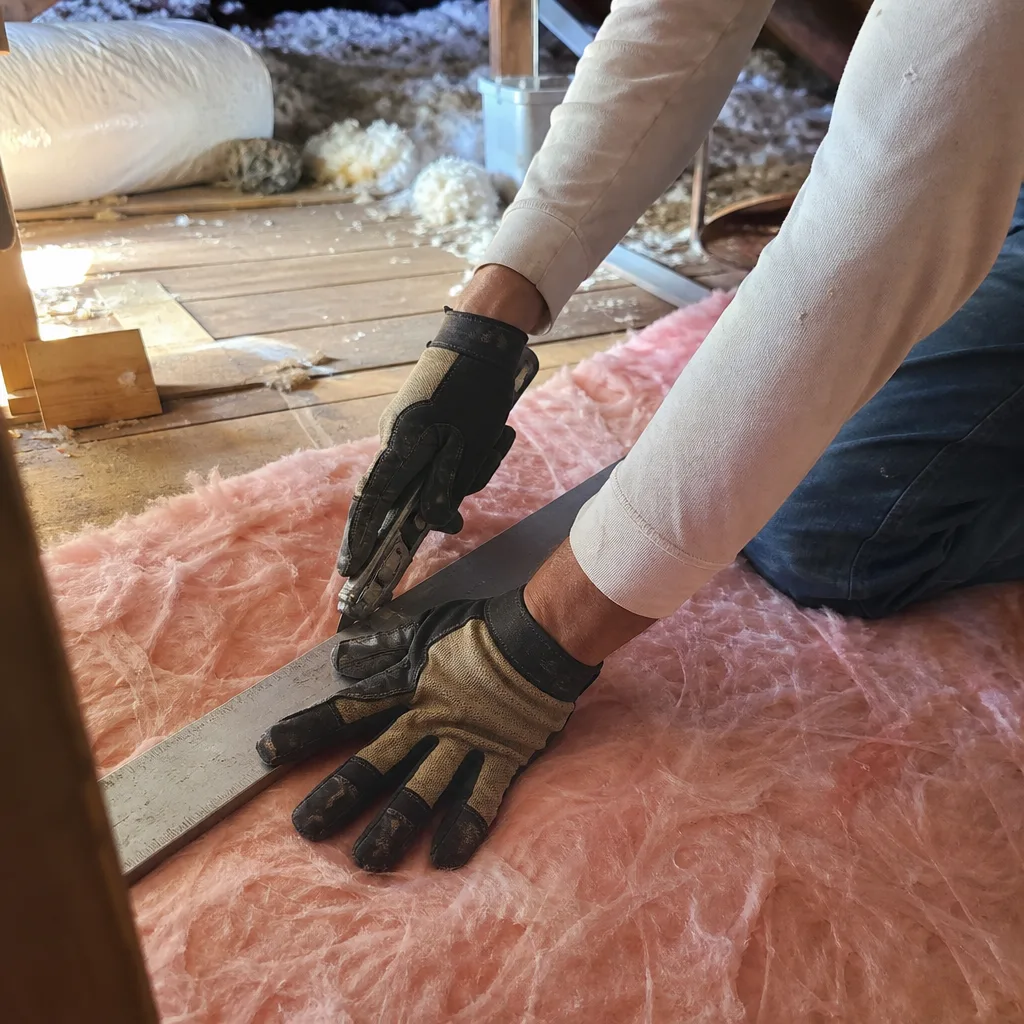
For blown-in top-ups, we typically work with Owens Corning blown fiberglass and GreenFiber cellulose. The choice depends on what’s already in the attic, the target R-value, and specific site conditions. We don’t use proprietary products that lock you into a single brand for future service, and we’ll explain the material choice in the written scope before work starts.
Both products perform well in Long Beach’s Climate Zone 6. GreenFiber cellulose has slightly higher density, which can be useful in attics where the existing material has compressed significantly and a heavier top layer helps maintain depth over time. Owens Corning blown fiberglass installs quickly and cleanly in standard attic conditions and is the more common choice for straightforward top-ups.
For air sealing, we use low-expansion spray foam at framing penetrations and fire-rated caulk around recessed light fixtures – never the wrong product in the wrong location.
FAQs – Attic Insulation Top-Up in Long Beach
Can you top up insulation without removing what’s already there?
Yes, in most cases. If the existing insulation is free of significant moisture damage, mold, rodent contamination, or vermiculite (an older material that may contain asbestos in pre-1980 homes), we can blow new material directly over it. We check for all of these conditions during the pre-job inspection. If we find a reason the existing material needs to come out first, we’ll document it and give you a written price for the removal before any work proceeds. Call (424) 415-7031 and we can walk through your specific situation.
How long does an attic insulation top-up take in Long Beach?
Most top-ups on a standard Long Beach home – 1,200 to 1,800 square feet of attic floor – are complete within 4 to 6 hours, including the pre- and post-job blower-door readings and air sealing. Larger attics or those with significant access constraints may run a full day. We give you a time estimate in the written scope so you know what to plan around.
Will a top-up actually lower my energy bills?
That depends on how much of your conditioned-air loss is attributable to the attic, which is exactly what the pre-job blower-door test tells us. In homes where the attic is the primary source of heat gain and air leakage – which is more common in Long Beach’s older housing stock than most homeowners expect – a top-up with proper air sealing can reduce cooling load meaningfully. We give you before-and-after numbers so you can measure the result yourself rather than taking our word for it.
Do I need a permit for an attic insulation top-up in Long Beach?
In most cases, a simple top-up on an existing residential attic in Long Beach does not require a building permit. However, if the work is part of a larger renovation or if the home is subject to specific zoning conditions, a permit may apply. We confirm permit requirements for your address during the estimate process and handle any required documentation if a permit is needed. We don’t start work in an ambiguous situation – that’s part of what the written scope covers.
Key Takeaways
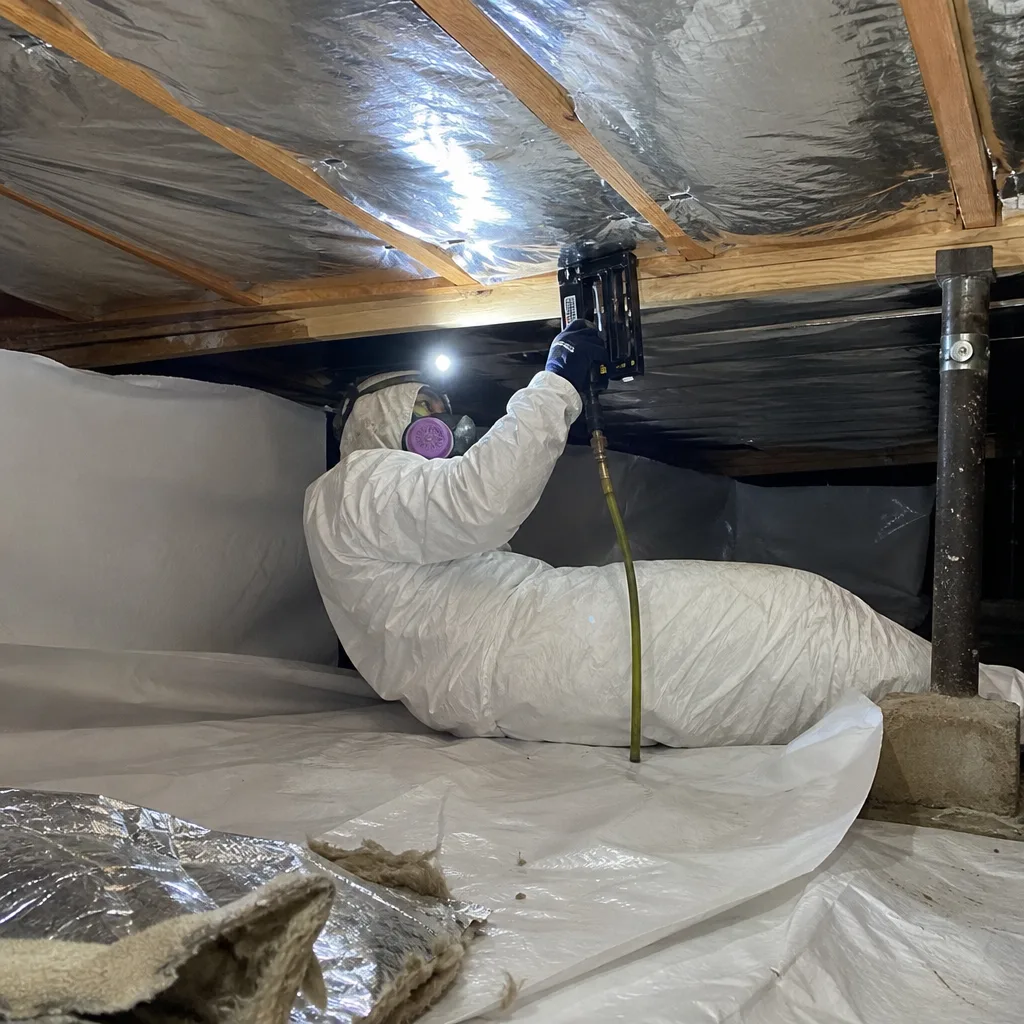
- A top-up brings existing insulation up to California’s Title 24 R-38 (or R-49) target for Climate Zone 6 – Long Beach’s energy code zone.
- Air sealing of top plates, can lights, and penetrations is completed before any new insulation is added. This is not optional and not an upsell.
- Before-and-after blower-door readings are provided on every applicable job so you can verify the result in a single measurable number.
- Most Long Beach top-ups cost between $900 and $2,800. The exact written price is delivered before any work starts, under Haven Standard Clause 1.
- The 365-Day Done Right Promise applies. If it’s not right, we make it right – in writing.
- A documented photo record is included on every visit, not available on request.
Schedule Your Free Estimate in Long Beach
If your Long Beach home’s attic insulation is below code depth, or you’ve been living with rooms that run warm regardless of what the thermostat says, a top-up with proper air sealing is likely the most cost-effective correction available to you. We serve homes across Long Beach – from Lakewood Village and Los Cerritos to Poly High and the Virginia Country Club area – with the same written-price, documented-result process on every job.
To get a written price before any work starts, call (424) 415-7031. A live person answers 24/7 – no voicemail, no callback window. If you have a written estimate from another contractor, bring it to the appointment. We’ll read through it with you at no charge.
You can also learn more about the full scope of what we do on our home page, or review the complete range of our Long Beach attic work under Attic Insulation in Long Beach.
Written by Wes Okafor, Owner at Topside Attic Insulation Long Beach, serving Long Beach since 2016.